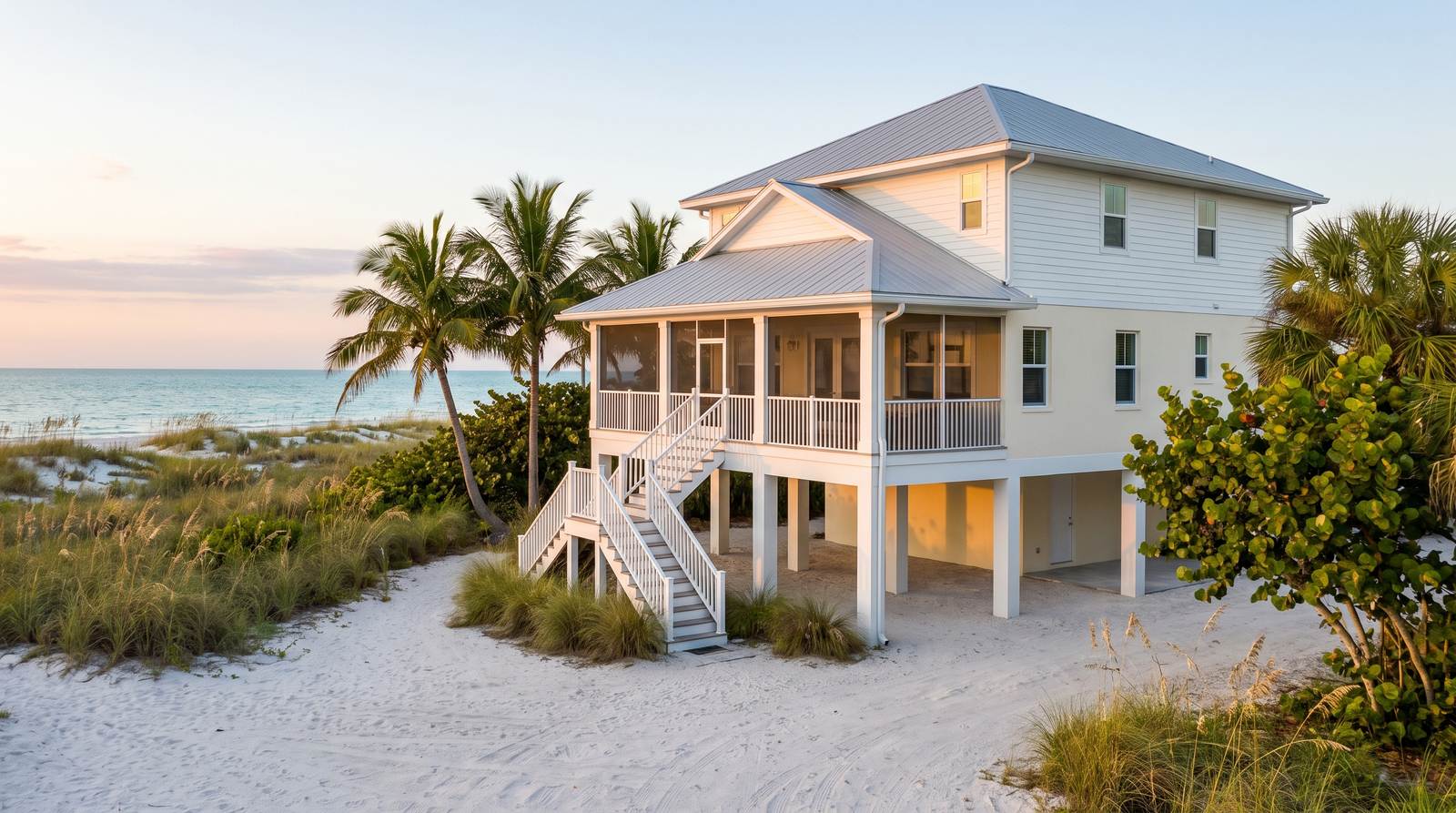
Second home loans in Florida
The largest second home market on this list, and the one where the building you buy into, and what it costs to insure, decide the timeline far more often than the loan does.
Where second home buying concentrates in Florida
Florida is several distinct second home markets that happen to share a state line, and the differences between them are real on a loan file.
- The Emerald Coast panhandle, from Pensacola Beach through Destin, the 30A communities and Panama City Beach. Heavily condominium, heavily rented, and the market where the occupancy question comes up most bluntly.
- Naples, Marco Island and Bonita Springs in southwest Florida, a mix of high rise condominium, low rise coach homes and golf community ownership, much of it seasonal.
- Sarasota, Siesta Key, Longboat Key and Anna Maria Island, where an older mid-rise condominium stock sits alongside newer construction, and building age matters to the review.
- The Florida Keys, from Key Largo to Key West, a constrained market with its own insurance, elevation and permitting realities.
- The Palm Beaches and Jupiter on the southeast coast, along with Vero Beach further north, a market with substantial single-family alongside the condominium stock.
- Amelia Island and the northeast Atlantic coast, including Ponte Vedra and St. Augustine, quieter and more single-family than the Gulf equivalents.
- The interior lakes and golf communities, around Orlando and Ocala, where a second home is often a house in a managed community rather than anything on the water.
Those are descriptions of where the market is, not a claim about prices or returns. In Florida more than anywhere else, the specific building is the file.
Source: U.S. Census Bureau, American Community Survey 5-year estimates, 2023, tables B25004 and B25001.
What usually decides a Florida file
Condominium project review is the Florida bottleneck
When you buy a condominium, the lender reviews the project alongside your file, and Florida is where that review most often becomes the critical path. The questions are about the association rather than about you: how the budget treats reserves, what the insurance covers, whether there is litigation, how much of the building is investor owned, and what any structural inspection has found. Building age and coastal exposure both make those questions heavier.
The practical move is to request the association documents at the same time as the inspection, not after it. On an older coastal building, allow real time for it.
Insurance, which is a Florida line item rather than a formality
Coverage has to be bound before closing, and on the coast that involves wind and flood considerations that do not arise inland. Start the insurance conversation when you go under contract rather than in the final week, because in some Florida markets it is the item that sets the closing date.
The rental question, in the state where it is loudest
A great many Florida coastal properties are marketed with rental income projections attached. On a second home purchase that income counts for nothing in qualifying, and an arrangement handing a management company control over the occupancy conflicts with the second home definition outright: a second home cannot be subject to any agreements that give a management firm control over the occupancy
, and it must be under the borrower's exclusive control. If the plan is genuinely a rental business, that is an investment property, and the Eligibility Matrix caps a one-unit investment purchase at 85% loan-to-value against 90% for a second home, with six months of reserves under Desktop Underwriter rather than two.
Source: Fannie Mae Selling Guide B2-1.1-01, Occupancy Types.
From Bryan’s desk. Florida ties Montana as the third most common state for Bryan’s second home buyers. The out-of-state surprise here is that wind and flood coverage can be separate policies on top of a standard homeowners policy in hurricane zones, and together they change the monthly cost more than buyers expect. Price insurance as soon as you have a specific property in mind.
Bryan Piccolomini, NMLS #228509, in an interview for this site, October 2026. Most homeowners policies do not cover flood: FloodSmart.gov (NFIP).
Which guides matter most here
For a Florida purchase, these three carry most of the weight.
Licensing in Florida
Residential Mortgage, LLC is authorized to close loans in Florida, one of the 27 states on the company's published authorization list. Bryan Piccolomini holds NMLS #228509 and Residential Mortgage, LLC holds NMLS #167729. Both can be checked independently on NMLS Consumer Access. Fuller detail is on the licensing page.
Common questions
Can Bryan lend on a second home in Florida?
Yes. Residential Mortgage, LLC is authorized to close loans in Florida, one of the 27 states on the company's published list, and Bryan Piccolomini holds NMLS #228509.
Why does a Florida condominium take longer than a house?
Because the lender reviews the project as well as the borrower. The association's budget, reserves, insurance, litigation and owner-occupancy mix all feed that review, and on older coastal buildings the structural and reserve questions are heavier. Requesting the association documents early is the single most useful thing a buyer can do.
Can I rent my Florida place out when I am not using it?
Occasional rental is contemplated on a second home, but the income cannot be used to qualify, and the property cannot be subject to an agreement giving a management firm control over the occupancy. A unit enrolled in a mandatory building rental program is a different conversation, and often a different loan.
How early should I deal with insurance?
As soon as you are under contract. Coverage has to be in place at closing, and in coastal Florida the availability and terms of that coverage vary enough by building and location that it is worth treating as a parallel task rather than a closing formality.
More states: all 27. Run the arithmetic first on the calculators page.
Send Bryan the building
On a Florida condominium, the association documents and the insurance quote are what set the closing date.